

Study: Why Everyday Objects Inspire Painting Themes
- by Paint by number online
-

Everyday objects - like a coffee cup, a vase, or worn shoes - can spark artistic inspiration. A 2025 study published in Communications Biology explains why: our brains derive emotional meaning directly from familiar items, processed by the lateral occipital complex (responsible for object recognition). Here's what you need to know:
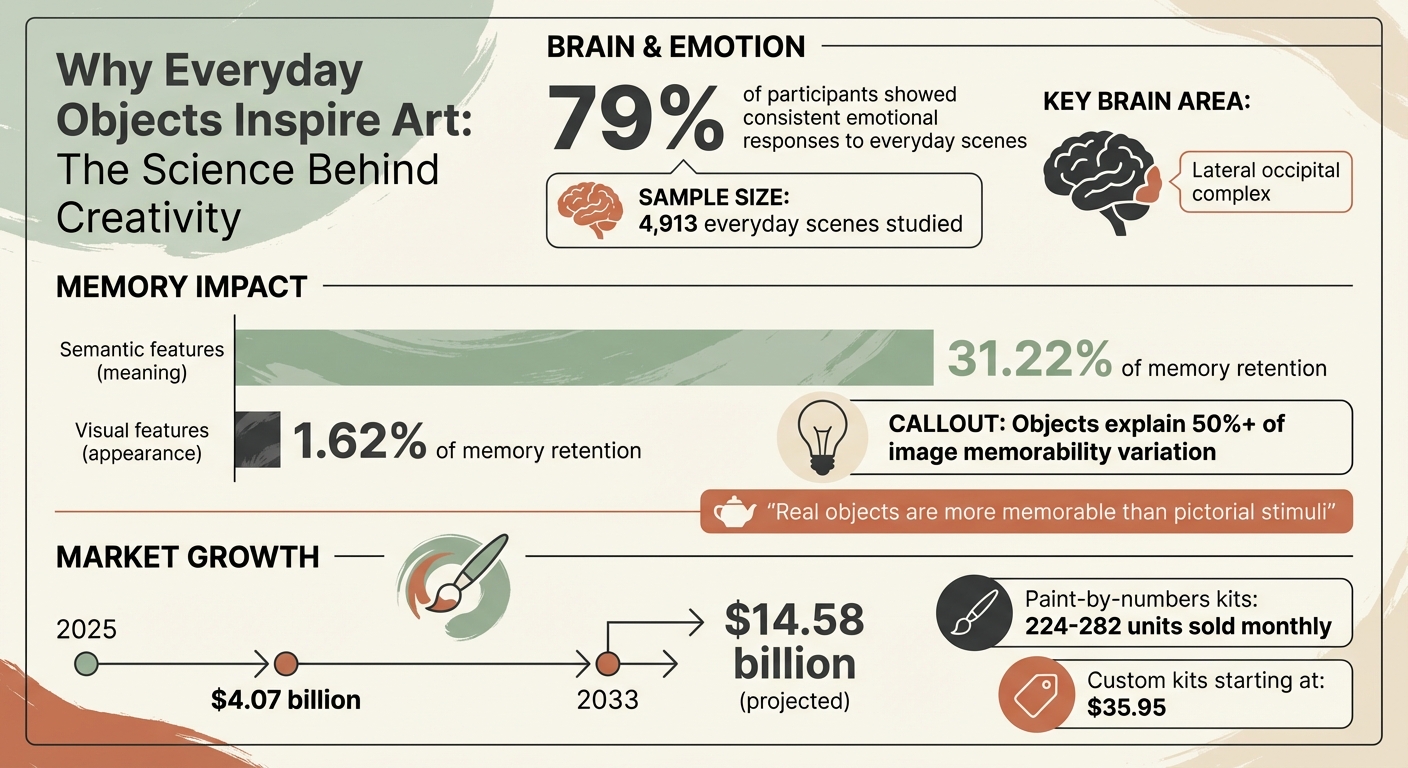
- Key Findings: 79% of participants showed consistent emotional responses to 4,913 everyday scenes, tied to the objects themselves rather than emotion-specific brain systems.
- Memory Impact: Research shows objects with meaningful associations are more memorable than abstract visuals, with semantic features influencing 31.22% of memory retention.
- Art Connection: Artists like Giorgio Morandi turned simple household items into powerful works, proving that meaning outweighs visual complexity.
- Paint-by-Numbers Trend: Custom kits let you transform photos of everyday items into personal art projects, blending emotional connection with hands-on creativity.
Want to create something meaningful? Start with the objects around you - they hold more potential than you might think.
How Everyday Objects Inspire Art: Key Research Findings
Main Research Findings on Everyday Objects and Creativity
How the Mind Finds Inspiration in Ordinary Items
Research highlights that an object's meaning plays a key role in sparking creativity. A study from May 2024, led by Kramer et al., analyzed over 1 million memory ratings for 26,107 object images. The findings revealed that semantic features - what an object represents and its significance - have a much greater impact on memory and inspiration than visual details like color or shape. Specifically, semantic dimensions accounted for 31.22% of an object's memorability, while visual aspects contributed only 1.62%. In fact, memorability scores for individual objects explained more than 50% of the variation in how well people remembered an image.
This phenomenon, often referred to as "semantic primacy", explains why items like a well-used coffee mug or a cherished heirloom teapot can inspire far more creativity than abstract forms. Our brains connect deeply with the meaning and stories behind these objects, rather than focusing solely on their appearance. Additionally, researchers have identified what they call "object agency" - the idea that an object's physical characteristics actively influence creative engagement. This suggests that working with real, tangible objects fosters a stronger cognitive and creative connection than simply viewing a photograph.
These findings resonate strongly with artistic practices and how creators interact with everyday items.
Real Examples of Everyday Object-Based Art
The connection between ordinary objects and artistic creativity is clearly evident in the work of renowned artists. Take Giorgio Morandi, for instance. The Italian painter spent his career exploring the visual potential of simple household items like bottles, jars, and vases. By repeatedly arranging and observing these everyday objects, he demonstrated how seemingly mundane items could achieve profound aesthetic impact through thoughtful composition and attention to detail.
Modern research backs up this artistic approach. In October 2014, a study by Jacqueline C. Snow and her colleagues at the University of Nevada, Reno, involved 172 psychology students who were asked to recall and recognize 44 common household objects presented as real items, color photos, or line drawings. The results showed that tangible, physical objects left a stronger impression on memory than their photographic or drawn counterparts. As Jacqueline C. Snow explained:
"Real objects are more memorable than pictorial stimuli."
Artist Katherine Kesey echoed this sentiment in her own words:
"When you paint ordinary objects, you can find the content just by existing."
These insights affirm that you don’t need exotic or extraordinary subjects to create meaningful art. The everyday objects around you - whether it’s a vase, a teapot, or a coffee mug - hold untapped creative potential. This idea has even found its way into modern paint-by-numbers designs, reflecting the enduring appeal of ordinary items in artistic expression.
sbb-itb-68cf19f
Historical Background: Everyday Objects in Art Movements
Cubism and Found Art
In 1912, Pablo Picasso shook up the art world with his piece Still Life with Chair Caning. By attaching oilcloth printed with a chair-caning pattern to a canvas and framing it with rope, Picasso introduced the use of found objects in modern art. This bold move questioned the long-held belief that art had to be entirely handmade.
The idea caught on, with Cubists like Picasso and Georges Braque incorporating mass-produced materials - such as wallpaper and newspaper clippings - into their collages starting in 1912. Braque himself reflected on this approach, stating:
The painter thinks in shapes and colours, the object is poetics.
By blending everyday materials with traditional art techniques, these artists created a bridge between the flatness of two-dimensional art and the tangible world of three-dimensional objects. Their work didn't just expand the range of materials considered "artistic" but also set the stage for a deeper exploration of how ordinary items could redefine art.
Marcel Duchamp took this concept even further with his "readymades." In February 1914, he casually purchased a galvanized iron Bottle Rack from a Paris store and declared it art. A few years later, in April 1917, Duchamp - using the pseudonym "R. Mutt" - submitted Fountain, a porcelain urinal, to the Society of Independent Artists exhibition in New York. Though the piece was rejected, the uproar it caused forever shifted the perception of art, emphasizing intellectual engagement over traditional craftsmanship.
How Art Movements Changed Views on Ordinary Items
The rise of industrialization brought an influx of mass-produced goods, while the disillusionment following World War I fueled a desire to question established norms. This cultural backdrop gave rise to movements like Dada, which embraced found objects as a way to challenge conventional ideas of art . Duchamp perfectly captured this shift when he explained:
The choice of readymades is always based on visual indifference and, at the same time, on the total absence of good or bad taste.
This reimagining of the everyday object laid the groundwork for countless contemporary art practices. By understanding how these movements transformed perceptions of ordinary items, we can better appreciate how they continue to inspire modern creativity, from avant-garde installations to personalized paint-by-numbers projects.
How This Applies to Paint-by-Numbers Designs
Turning Everyday Items into Art
Imagine turning the most ordinary household items - like a teapot or a kitchen sink - into stunning works of art. With the help of software, photos of these everyday objects are analyzed for their shapes, shadows, and color variations. From there, the image is divided into numbered sections, typically using a palette of 24 to 30 colors, making it easier for anyone to recreate the scene with paint.
Artist Brian Parker explains his vision:
My aim was to capture the beauty of the teapot's curves and colour: draw the viewer in enough for them to want to reach out, cup its shapes in their hands and feel its warmth.
This same approach can be applied to other objects, like a coffee pot or even a favorite chair, turning them into rewarding painting projects that might take anywhere from 10 to 20 hours to complete.
The growing appeal of accessible art is reflected in market trends. For example, the global art paint market, valued at $4.07 billion in 2025, is expected to grow to nearly $14.58 billion by 2033. Paint-by-numbers kits for adults are also in high demand, with monthly sales ranging from 224 to 282 units, especially peaking during the summer months.
This combination of technology and creativity is making personalized art more accessible than ever.
Custom Photo-to-Canvas Kits
For a more personal touch, Paint by Numbers Online offers custom kits that turn your cherished photos into paint-by-numbers projects. Whether it’s a picture of your first home, a beloved piece of furniture, or a family heirloom, these kits allow you to create a meaningful keepsake. A company representative explains:
The goal isn't to replicate every pixel perfectly but to capture the essence and emotion of your photo.
To achieve the best results, it’s recommended to use high-resolution images (at least 1,000 pixels) with good lighting and a simple background. The software performs best when the subject is clear and uncluttered. These custom kits start at $35.95 and come with everything you need: a pre-printed numbered canvas, custom-mixed acrylic paints, and three brushes tailored for different levels of detail.
This approach turns leisure time into an opportunity for creating personalized decor, blending relaxation with a sense of accomplishment.
Conclusion
Main Points to Remember
Everyday objects - like the curves of a teapot or the wear on a favorite chair - hold immense potential to inspire creativity. Studies reveal that tangible objects are far more memorable than photographs or drawings, thanks to their depth and the possibility of physical interaction. This idea, known as object agency, highlights how items influence human behavior and spark artistic engagement. Beyond fueling creativity, these objects can transform your surroundings into a personal gallery of art.
Paint-by-numbers kits bring this idea to life in a hands-on way. Since their debut in 1951 by Dan Robbins and Max S. Klein, with over 12 million "Craft Master" kits sold, these kits have proven that anyone can create art. The structured nature of these kits encourages a "flow state", helping to reduce stress and promote relaxation by lowering cortisol levels.
So, why not channel this creative energy into your next paint-by-numbers project?
Start Your Own Project
Take this inspiration and turn your everyday moments into art. Paint by Numbers Online offers a range of options, from pre-designed kits starting at $29.99 to custom photo-to-canvas kits beginning at $35.95. Whether you pick a still-life design featuring household objects or choose to immortalize a cherished photograph, you'll have everything you need to get started.
As artist Brian Parker puts it:
No matter how humble the subject, I never forget its impact can be truly extraordinary.
Your kitchen table, a potted plant, or even your morning coffee can become the centerpiece of a rewarding art project that blends relaxation with a sense of accomplishment.
Finding Creative Inspiration in Everyday Objects
FAQs
Why do familiar objects feel more inspiring than abstract subjects?
Familiar objects often spark more creativity than abstract concepts because they tap into personal and emotional connections. Everyday items can carry memories or sentimental value, anchoring creative work in real-life experiences. Research indicates that tangible, recognizable objects are more engaging and easier to remember, enabling artists to craft pieces that feel genuine and emotionally impactful. These connections to the familiar can lead to richer inspiration and a more meaningful creative process.
How can I pick an everyday object that will make a strong painting theme?
To pick a compelling painting theme, start with everyday objects that resonate with you - things you see or use daily that hold some visual charm or emotional connection. A set of keys, a spoon, or a vase of flowers can all be great choices. Pay attention to textures, patterns, or the way light interacts with the object, as these details can add depth and character to your work. Choosing something familiar and personally meaningful often results in a painting that feels more authentic and engaging.
What makes a good photo for a custom paint-by-numbers kit?
To create a great custom paint-by-numbers kit, start with a high-resolution photo that's clear and sharp. Choose an image with a simple composition where the subject fills most of the frame. Photos with strong contrasts work best, as they help highlight details in the final painting. Steer clear of images with overly busy backgrounds or low-quality resolution, as these can make the painting process more challenging and less enjoyable.
